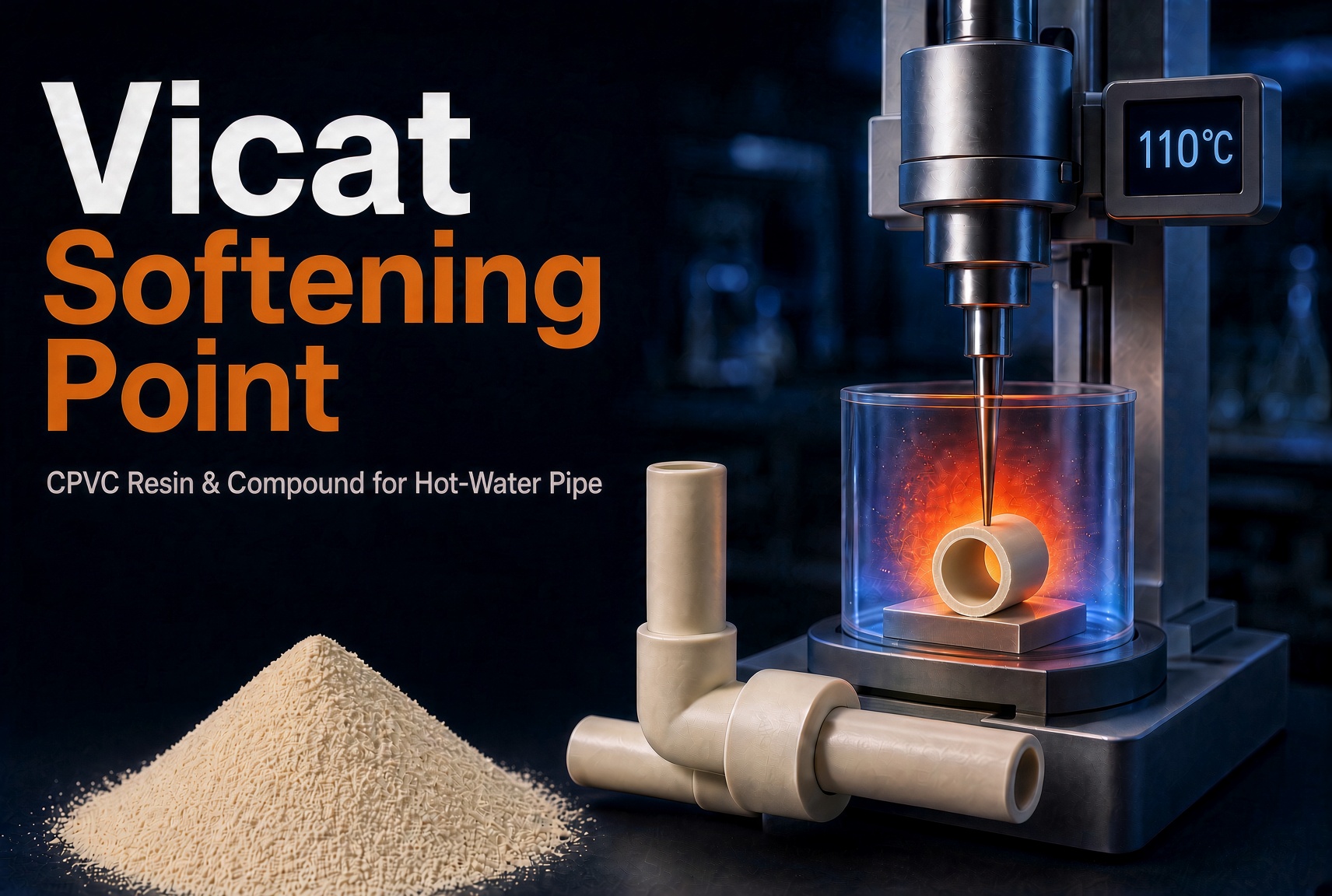
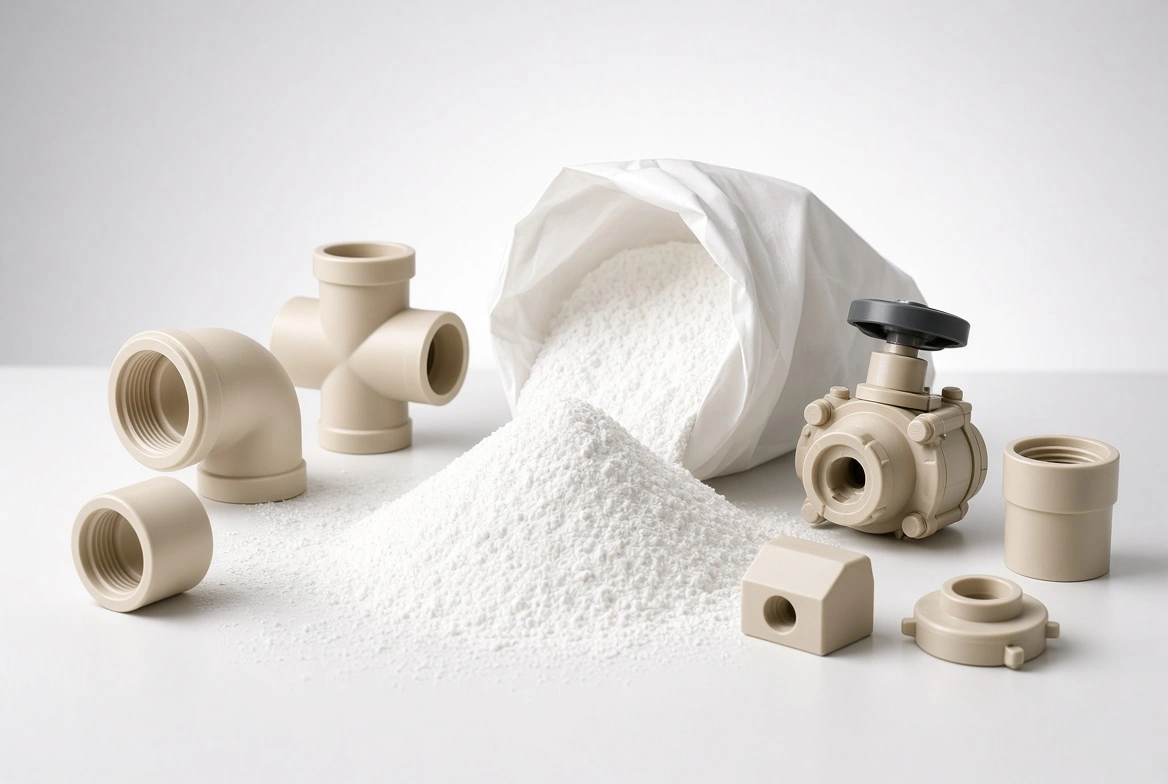
Injection-molded fittings, valves, and complex molded parts need injection-grade CPVC resin. Extrusion-grade resin is designed for pipe production and does not deliver the flow, packing, and knit-line performance these parts require. Using the wrong base resin leads to incomplete fill, weak weld lines, dimensional inconsistency, and higher scrap rates.
This guide explains the specific challenges formulators and molders face, and how to select the right injection-grade resin.
Why Injection-Grade Resin Is Required
Pipe extrusion and injection molding place opposite priorities on the resin:
- Extrusion prioritizes melt strength to hold the pipe shape as it leaves the die.
- Injection molding prioritizes filling long flow paths, thin walls, and complex geometries under higher shear, then forming durable knit lines.
An injection-grade resin is positioned for this window. Its molecular-weight characteristics, chlorine content range, and thermal stability support filling and packing without excessive degradation. For the formulator, the base resin sets the available processing latitude and determines how consistently the final compound will perform on critical parts.
1. Fittings — Flow Paths, Transitions, and Dimensions
What goes wrong
- Long flow lengths and sudden wall-thickness changes
- Incomplete fill, flow marks, or flash at transitions
- Knit lines forming in high-stress zones
- Poor surface quality on socket and solvent-weld areas
Why it matters
Weak weld lines cause pressure-test failures or long-term creep. Rough or inconsistent solvent-weld surfaces reduce joint strength and increase leak risk. Result: higher scrap, inconsistent fit-up, or costly field failures.
2. Valves — Sealing Surfaces and Pressure Integrity
What goes wrong
- Imprecise sealing grooves and seating surfaces
- Inadequate packing of thick sections
- Weak knit lines under system pressure and operating torque
- Dimensional drift under heat or chemical exposure
Why it matters
Sealing performance suffers, pressure-test rejection rates rise, and premature cracking can appear in service—especially with hot water or aggressive chemicals.
3. Complex Molded Parts — Geometry and Consistency
What goes wrong
- Thin walls, deep ribs, and large projected areas
- High sensitivity to melt viscosity and packing behavior
- Batch-to-batch dimensional variation
- Surface and demolding issues with complex tooling
Why it matters
Dimensional inconsistency becomes an assembly or leak-test problem. Warpage, longer cycle times, and unstable yields follow when the resin is not matched to the geometry.
How Injection-Grade Resin Helps
A purpose-designed injection-grade CPVC resin supports these parts in four practical ways:
- Better flow — fills long paths and thin sections without excessive pressure or degradation
- Adequate thermal stability — protects the polymer during higher shear and longer residence times
- Consistent particle size and low volatiles — promote uniform melting and reduce surface defects
- More formulation latitude — gives room to balance lubricants, stabilizers, and impact modifiers
Result: more reliable knit-line strength, tighter dimensional control, and a more predictable processing window.
4 Setps to Select the Right Resin
Not every CPVC resin is formulated for injection molding of fittings and valves. Matching the base resin to the injection window reduces trial-and-error and improves first-pass success. Here goes the selection sequence:
- Define part priorities
- Fittings → dimensional stability, weld-line strength, surface quality for solvent welding
- Valves → sealing-surface precision, pressure integrity, chemical resistance
- Complex molded parts → flow window, low warpage, surface consistency
- Match the resin to the injection window
Look for suitable chlorine content and Vicat range, thermal stability for expected cycle times, and particle-size/volatile characteristics that support clean melting.
- Check formulation compatibility
Confirm the resin works with common stabilizers, lubricants, and impact modifiers, and leaves enough processing latitude for production-scale molding.
- Validate on real parts
Run critical geometries—especially those with knit lines or sealing surfaces. Prioritize checking knit-line location and strength, plus dimensional accuracy on sealing surfaces and solvent-weld areas. Assess fill, surface quality, and short-term pressure or chemical performance before scaling.
Choosing a Base Resin
Once the requirements are clear, select a consistent injection-grade CPVC resin designed for these applications.
Xuye Z-500 is an injection-grade CPVC resin developed for formulation teams working on fittings, valves, and molded components. With chlorine content ≥66%, it provides the base material characteristics needed to support the flow, thermal stability, and dimensional performance outlined above.
Full specifications, test data, and sample support:
Xuye Z-500 injection-grade CPVC resin
Closing
Fittings, valves, and complex molded parts require injection-grade CPVC resin. Extrusion-grade materials are not optimized for their flow, knit-line, and dimensional demands. Understanding these challenges and following a clear selection sequence reduces development time and improves first-pass success.
Start with a purpose-designed injection-grade resin and validate on critical geometries. When ready to review data or request samples, use the Z-500 product page for specifications and technical support.