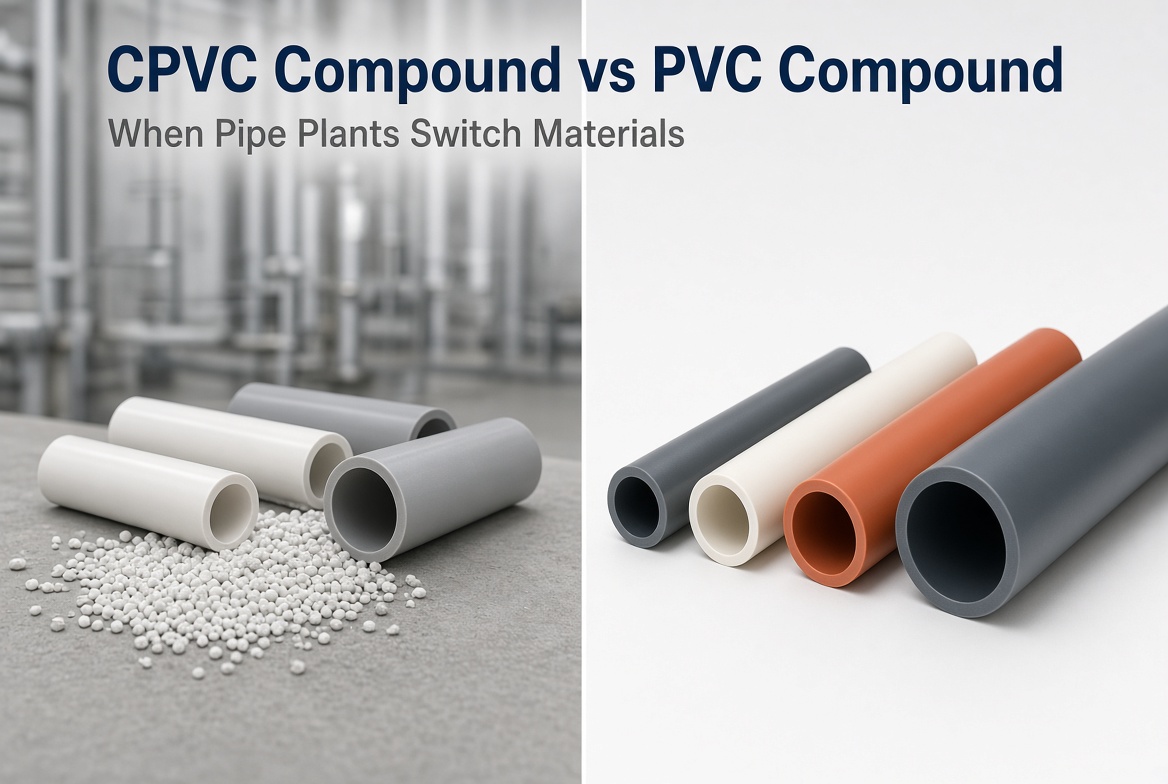
A hot-water line can use chlorinated polyvinyl chloride (CPVC). The pipe and the fittings have to be made from a hot-water CPVC compound, not from standard PVC, and the extrusion line and the injection press do not run the same grade.
Can You Run CPVC on a Hot-Water Line?
Yes, if the pipe and fittings are made from a hot-water CPVC compound. Standard PVC is a different material. A resin with no compound package is not yet a pipe material.
CPVC and PVC do not share a temperature ceiling
PVC pressure pipe is commonly limited to about 60°C / 140°F. On Xuye’s compound page, the hot-water service reference for pipe made from CPVC compound is up to 93°C. That figure is a service reference. It is not a softening point, and it is not a rating that every finished pipe automatically carries. A line already running PVC compound should not treat the 93°C reference as a drop-in change. The switch decision is covered in when pipe plants switch materials.
Vicat is the number people mix up with that reference. It is the temperature at which a needle starts to sink into the compound under a set load. Use it as a floor when you choose a grade. Do not use it as the temperature the line runs at. A Vicat of 110°C does not make a 110°C pipe.
The wider material contrast is on the CPVC vs PVC page. The rest of this page stays with the production choice.
Buy compound to run, buy resin to formulate
The industry order is resin, then compound, then pipe or fitting. Compounding adds the heat stabilizer, lubricants, and pigment package before the material is extruded or molded. Plants that do not want to build that package buy the compound. Plants that already formulate buy the resin.
- J-700C and Z-500C are the ready-to-run compounds.
- J-700 and Z-500 are resins for a formulation team.
- A resin grade is not a drop-in for a hot-water pipe line.
Powder or pellet is only the form supplied. The product name is CPVC compound. Buying resin because the name looks similar will leave the line without the package it was trialed on.
Which Grade Goes on Which Machine?
One hot-water system still needs two materials. Pipe is extruded. Fittings and valves are molded. Flow, weld lines, and heat history are not the same, so the grade should not be shared to simplify purchasing.
J-700C for pipe, Z-500C for fittings and valves
J-700C is the extrusion compound for hot- and cold-water pipe, industrial pipe, and fire-protection pipe. Vicat is ≥110°C / ≥230°F. Z-500C is the injection compound for fittings, valves, and fire-protection fittings. Vicat is ≥103°C / ≥217.4°F.
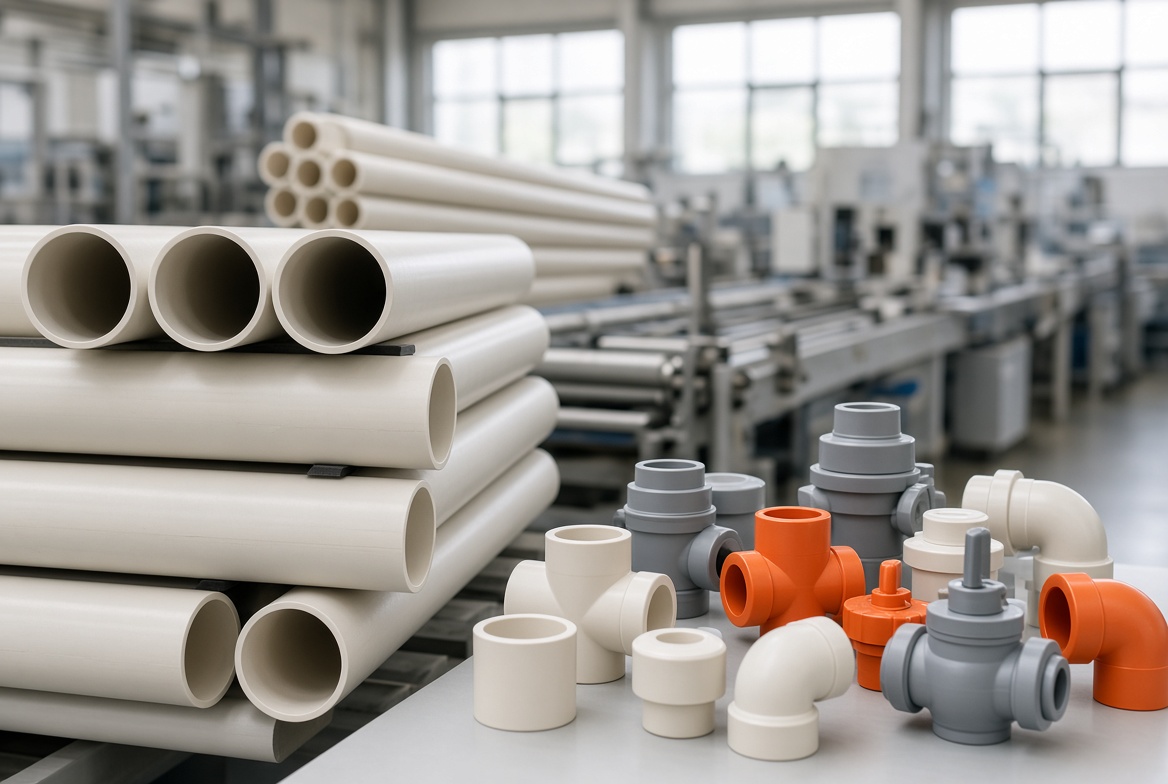
Fire-protection fittings stay on Z-500C. They do not move to a lower Vicat floor because the line is a sprinkler line. Ivory, gray, and orange are identification colors, so a mixed bin is visible before it reaches the hopper.
Check Vicat before the hot-water trial
A smooth trial surface is not a hot-water approval. Under-spec Vicat can extrude or fill a mold cleanly and still soften or lose shape once the line is hot.
Some fitting compounds publish a Vicat of 100°C. Check the floor before the trial. Z-500C is held at ≥103°C, and J-700C at ≥110°C. That check is a number on the lot, not a story about the recipe.
Which Process Faults Show Up Only in Hot Water?
The plant sets the barrel curve. This page does not. What matters here is which faults a cold pressure test can miss.
Extruded pipe: weak fusion and shrinkage
Pipe that is under-fused can hold a cold test and still creep or split once it is hot. Longitudinal shrinkage tied to the die shows up the same way: the cut length looks fine in the hall and moves after the line is in service.
If a hot-water complaint arrives with a good incoming Vicat, fusion and shrinkage are the first process checks. They are not a reason to change grade.
Molded fittings: residence time and weld-line stress
Fittings fail on a different clock. A long residence in the barrel uses up the heat-stability reserve before the part leaves the press. Fast cooling locks stress into the wall and into the weld line. The fitting can pass a cold test and crack after hot-water cycling.
That pattern points to residence time and cooling. It does not point to the wrong extrusion grade sitting in an injection hopper.
What Can You Take From the Datasheet?
The pre-trial checklist is the CPVC compound datasheet. It is not a brand claim, and it is not a finished-pipe certificate.
Numbers to put on the incoming sheet
Both compounds carry the same mechanical floor. Vicat does not.
- Density: 1.45–1.65 g/cm³
- Tensile strength: ≥50 MPa
- Tensile modulus: ≥2758 MPa
- Izod: ≥8.1 kJ/m²
- Flame rating: UL 94 V-0
- J-700C Vicat: ≥110°C / ≥230°F
- Z-500C Vicat: ≥103°C / ≥217.4°F
Put these on the incoming sheet and stop there. A higher figure on another supplier’s sheet is a different datasheet. It is not a reason to read these floors up.
NSF/ANSI/CAN 61 stops at the compound
The pipe and fitting compound is positioned against NSF/ANSI/CAN 61. That is a compound statement. It does not mean a pipe extruded from J-700C, or a fitting molded from Z-500C, is already listed to ASTM D2846, F441, or F439.
Those listings, where they are required, are finished-product work. They are done by the pipe plant, on the pipe or fitting, not on the bag of compound.
Hot Water, Industrial, or Fire Line?
Cold and hot water, industrial pipe, and fire-protection pipe are all on the compound page. The split is still by process, not by how hot the water is.
One grade does not cover both routes
Trial J-700C on the extrusion line for hot- and cold-water pipe, industrial pipe, and fire-protection pipe. Trial Z-500C on the injection press for fittings and valves on those same systems.
Running one grade on both machines saves a sku. It also puts an extrusion compound through a weld line, or an injection compound through a pipe die. That mismatch costs more than the second sku.
Pressure class is the pipe plant’s job
Wall, SDR, hydrostatic design, and the finished-pipe listing are set by the extruder or the molder. They are not compound specifications. A material floor does not choose the pressure class.
How Long Does It Last, and Where Should It Not Go?
Published service-life figures for CPVC pipe assume the right compound, full fusion, low molded-in stress, a correct joint, and normal water. They are not a material warranty. The “40 years” on the Xuye site is R&D experience, not a pipe life.
Life follows the plant, the joint, and the water
Field life tracks what the plant actually controls: fusion, molded-in stress, and the grade on the hopper. It also tracks the joint and the water, which the plant does not control after the pipe leaves.
A lot that meets Vicat can still fail if the pipe was under-fused or the fitting was cooled too fast. Do not read a 40- or 50-year figure as a Xuye guarantee.
Brittleness, freezing, sunlight, and the wrong cement
CPVC gets more brittle as it ages. It does not tolerate freezing the way a flexible pipe does. Outdoor sunlight needs protection. Those are use limits, not missing lines on the datasheet.
One installation fault is worth naming because it comes back as a material complaint. PVC cement on CPVC can look sealed and still let go after heat cycles. CPVC solvent cement is covered by ASTM F493. Xuye does not make that cement. The packing note is the right place to say so.
Lot figures for J-700C and Z-500C are on the compound pages. If you are setting a hot-water pipe or fitting line, send the process and the application — extrusion or injection, hot water, industrial, or fire protection — and the Xuye team will match the grade and walk through the datasheet before the trial.