
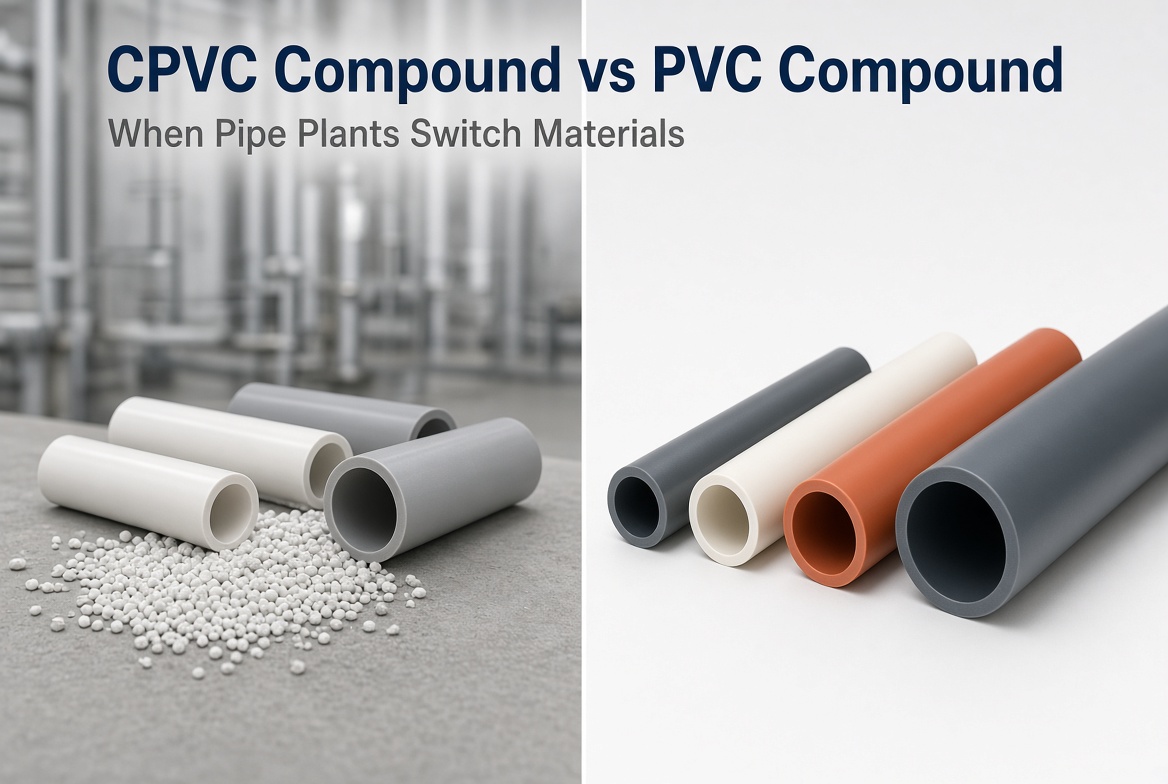
If you are adding hot-water potable pipe, industrial pipe, or fire-protection pipe and fittings, you should order CPVC compound, not another lot of PVC compound.
XUYE supplies CPVC compound in two machine routes. You specify the grade with our team by how you will run it.
| How you will run it | Grade to put on the PO | Vicat XUYE controls to (ASTM D1525, 0.49 MPa) |
| Pipe extrusion: hot and cold water, industrial, or fire-protection pipe | J-700C | 110 °C or higher (230 °F or higher) |
| Injection: fittings, valves, fire-protection parts | Z-500C | Z-500C |
Keep PVC compound on the lines that still make cold-water pipe, drainage, sewage, or irrigation. Adding stabilizer to a PVC compound will not give you a CPVC compound. The polymer, the Vicat gate, and the standard you print on the product are different.
If that product is potable, you can use XUYE pipe and fitting compound listed to NSF/ANSI/CAN 61 from the Changyi plant. That listing does not replace the tests you run on the pipe or fitting you ship.
When a plant should switch to CPVC compound, and when PVC compound stays
Use this page when you already know which product you will sell, and you need to lock which compound to order.
| What you want to run | Keep your PVC compound? | Order XUYE CPVC compound? | What to write on the RFQ |
| Cold-water pressure pipe, DWV, sewage, irrigation only | Yes | No | Stay on PVC compound |
| Add hot- and cold-water potable pipe | Only on lines that stay PVC | Yes | J-700C |
| Add industrial pipe | Only if that line stays ambient PVC service | Yes for the CPVC line | J-700C |
| Add fire-protection pipe | Not on that line | Yes | J-700C |
| Add fittings, valves, molded fire parts | Not on that press | Yes | Z-500C |
| Pipe and fittings in one plant | Split by machine | Yes, two lots | J-700C and Z-500C |
XUYE sells CPVC compound, not PVC compound. If you still need to choose resin powder versus ready compound, start with CPVC resin vs CPVC compound. This page assumes you have already decided to buy compound.
Four checks before you write a CPVC compound PO
Before you issue a PO, walk these four checks with our team. If any check fails, do not treat that bag as a drop-in for the new product.
Polymer family: CPVC compound, not a boosted PVC compound
You need CPVC compound on a CPVC resin base. PVC compound is the wrong base for hot-water, many
industrial, and fire-protection CPVC products. Adding stabilizer to a PVC compound will not give you a CPVC
compound.
Machine match: extrusion compound for pipe, injection compound for fittings
Extrusion grade for pipe; injection grade for molded parts. Do not ask for one unnamed melt to cover both.
Vicat on the CPVC compound TDS
Require 110 °C or higher on the pipe extrusion grade and 103 °C or higher on the injection grade (ASTM D1525,
0.49 MPa). If a supplier offers “CPVC” with a much lower Vicat, you are buying a quality risk into the pipe and
fittings you will have to stand behind.
NSF/ANSI/CAN 61 when the CPVC compound goes into potable pipe
Use compound listed to NSF/ANSI/CAN 61. You still test the finished pipe or fitting.
On J-700C and Z-500C, XUYE holds the same mechanical and flame floor, so you compare the two grades on process route, not on a moving spec sheet: density 1.45 to 1.65, tensile strength 50 MPa or higher, tensile modulus 2758 MPa or higher, UL94 V-0, Izod 8.1 kJ/m² or higher. You pick ivory, gray, or orange against the product you will mark. What you change on the PO is the machine and the Vicat gate, not a second tensile family.
What changes on a PVC compound line when you trial CPVC compound
You can usually keep the same layout. You should not keep the same settings, tooling hygiene, or QC targets.
What follows is how our team briefs plants that have only run PVC compound. It is an industry risk reminder, not a setting sheet. XUYE does not publish barrel temperature, screw L/D, or a purge-resin brand as a universal recipe. Review the line with your machine builder, then send us the machine type with the sample request.
| Item | What you probably do on PVC compound | What to assume on XUYE CPVC compound |
| Line layout | Mixer if you use one, then extruder or press, tool, cool, cut, inspect | Same sequence |
| Compound | PVC compound | J-700C on the extruder or Z-500C on the press |
| Melt | Lower viscosity, wider window | Stiffer melt, narrower heat-and-shear window |
| Screw and barrel | Wear package sized for PVC | Review corrosion, wear, torque, and temperature control before a production trial |
| Speed | Your current PVC rpm or injection speed | Start slower than your PVC habit. Do not copy PVC settings onto the first lot |
| Tooling | PVC gates and flow paths | Streamlined flow. No dead spots. Fitting tools often need more venting |
| Shutdown | Some plants hold a full barrel | Do not soak a full CPVC charge at processing temperature |
| Regrind | You may mix streams today | Do not mix PVC or other resins into CPVC regrind |
| First-lot QC | Your old PVC pipe or fitting spec | Compound Vicat on the XUYE TDS, plus the CPVC standard you will print on the product |
Same machines, different compound habits
The extruder or press can stay in the bay. Speed habit, shutdown habit, and the QC spec you print on the ticket
should not be copied from the PVC compound run.
Tooling hygiene before the first CPVC compound lot
Review screw, barrel, torque, and tooling with your machine builder first. A dirty transition from PVC compound will not give you a clean CPVC compound trial.
How to specify J-700C or Z-500C CPVC compound on the PO
Use this with your buyer and your process engineer in the same meeting. It is a grade gate, not a barrel-temperature calculator.
The three letters you agree in the meeting
- P is the product you will sell: pipe or fitting.
- M is the machine you will run: extrusion or injection.
- Vmin is the minimum Vicat you require on the compound TDS.
If P is pipe, M is extrusion, and Vmin is 110 °C or higher, specify J-700C.
If P is a fitting or valve, M is injection, and Vmin is 103 °C or higher, specify Z-500C.
If you run pipe and fittings, specify both grades. If the SKU stays cold-water or DWV PVC, do not switch that line.
When you write Vicat on the PO, use ASTM D1525 at 0.49 MPa. Do not mix that number with HDT, Tg, or a finished-pipe Vicat measured under another load or standard unless you say so on the RFQ.
What you are buying when you order XUYE CPVC compound
You are buying a ready-to-process CPVC compound so you do not have to rebuild a CPVC recipe on the mixer for the first CPVC products.
J-700C extrusion compound
J-700C is XUYE extrusion compound for hot and cold water pipes, industrial pipes, and fire-protection pipes. Vicat is controlled to 110 °C or higher (230 °F or higher).
Z-500C injection compound
Z-500C is XUYE injection compound for fittings, valves, and fire-protection fittings. Vicat is controlled to 103 °C or higher (217.4 °F or higher).
Both grades are produced at Changyi. Pipe and fitting compound is listed to NSF/ANSI/CAN 61.
This page will not promise a universal barrel curve, a mandatory screw L/D, or that every PVC screw in your bay will run unchanged.
When you request a trial, send the product standard, extrusion or injection, the grade, color, whether the line is potable, and a monthly volume range. That is enough for our team to put the right lot in front of your screw.
More detail sits on the CPVC compound product page.
How a CPVC compound switch looks on your floor
You run PVC pressure pipe and you are adding hot-water pipe. Keep PVC compound on the cold-water SKUs. Ask XUYE for J-700C on the new pipe line. Qualify the first lot against compound Vicat (110 °C or higher) and the hot-water pipe standard you will mark, not against the old PVC pipe spec alone.
You mold PVC fittings and you are adding CPVC fittings and valves. Have the press reviewed for torque, corrosion, and flow in the tool. Ask for Z-500C, not pipe extrusion compound. Keep mixed PVC and CPVC regrind off that press.
You will sell both CPVC pipe and CPVC fittings. You need two compounds: J-700C on the extruder and Z-500C on the press. Do not write one unnamed “universal CPVC compound” on the RFQ. That is not how XUYE splits the grades.
These are the paths our team uses when we brief a plant. They are not case studies with output, scrap, or cycle-time claims.
FAQ on switching from PVC compound to CPVC compound
When we switch materials, do we buy PVC compound or CPVC compound?
For hot-water potable pipe, industrial CPVC pipe, and fire-protection pipe or fittings, you buy CPVC compound from XUYE. You keep PVC compound only on products that stay PVC. XUYE does not sell PVC compound.
Can we run XUYE CPVC compound on a line that used to run PVC compound?
You can often evaluate the same type of extruder or press for a trial. Do not copy your PVC speeds, shutdown habits, or QC specs. Review screw, barrel, torque, and tooling first, then tell our team what you run.
Which grade do we put on the PO?
J-700C if you extrude pipe. Z-500C if you inject fittings and valves. If you run both, you order both from XUYE.
Does NSF/ANSI/CAN 61 on XUYE compound replace our pipe tests?
No. It is a material listing for pipe and fitting compound from Changyi. You still test the pipe or fitting you sell.
What Vicat should we require on the TDS?
J-700C: 110 °C or higher. Z-500C: 103 °C or higher. Method: ASTM D1525, 0.49 MPa.
Can we blend PVC regrind into XUYE CPVC compound?
No. Mixed regrind can collapse Vicat and mechanical values, which are the properties you switched materials to get.
Request a J-700C or Z-500C trial
Tell XUYE the machine, not a generic “CPVC” bag.
If you are adding pipe, request a J-700C trial.
If you are adding fittings or valves, request a Z-500C trial.
If you are adding both, request J-700C and Z-500C, and name the standard for each product.
Send that brief on the CPVC compound product page. Our team will match the grade to the line you described.

