CPVC resin chlorine content is an important purchasing specification. It is not a stand-alone rule for picking a grade.
If you formulate and compound in-house, evaluate the base resin. If you buy a prepared compound, evaluate the formulated material and its suitability for your production line. A resin chlorine figure alone does not set the temperature rating, pressure rating, or service life of a finished pipe.
This guide explains what to request from a supplier and what to verify before a production trial.
What Does Chlorine Content Mean in CPVC Resin?
CPVC is made by further chlorinating PVC resin. Chlorine content is the share of chlorine in the material, reported as a percentage. Chlorination changes the polymer structure and contributes to CPVC’s thermal characteristics. Ordinary PVC sits around 56–57%. CPVC is higher than 66%.
For extrusion and injection plants, the essential distinction is between the base resin, the compound and the finished product.
| Material | What the buyer should evaluate |
| CPVC resin | Resin specifications and suitability for the intended formulation |
| CPVC compound | The formulated material’s properties, processing requirements, and application suitability |
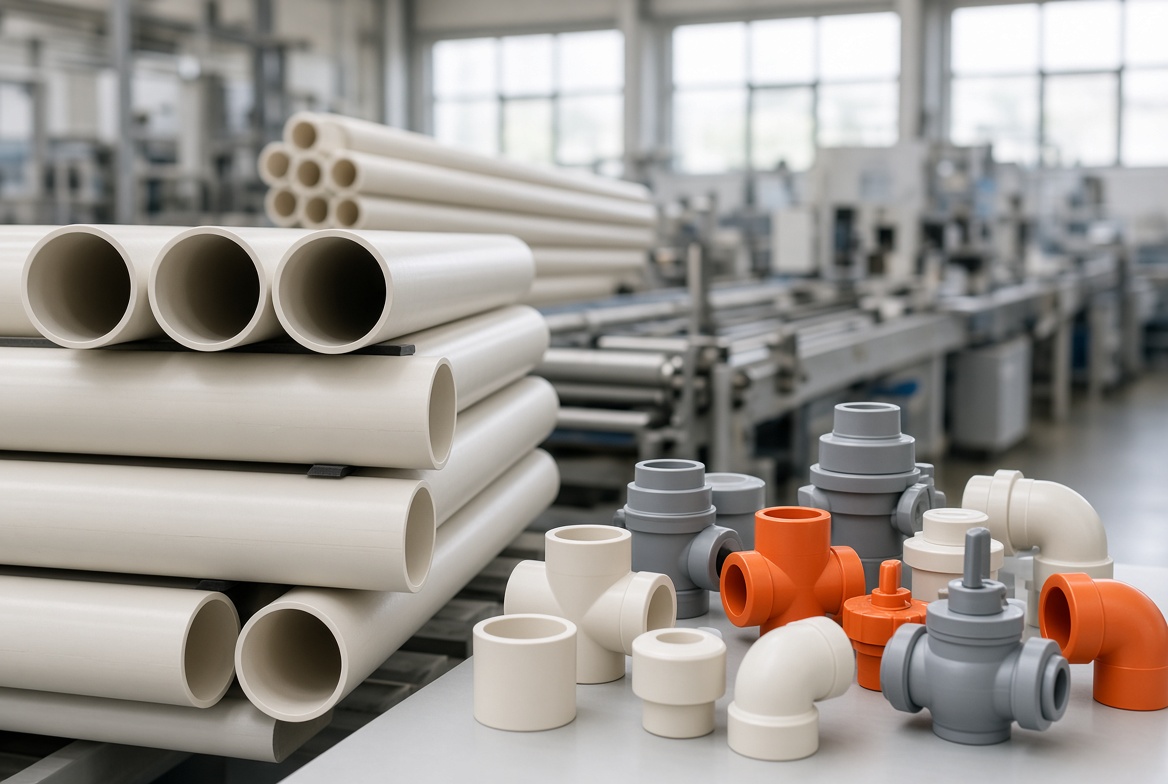
| Finished pipe or fitting | Dimensions, performance tests, and requirements for the intended service conditions |
When a supplier reports chlorine content, ask whether the figure refers to the base resin or the complete compound. Also confirm the test and reporting basis before you compare results.
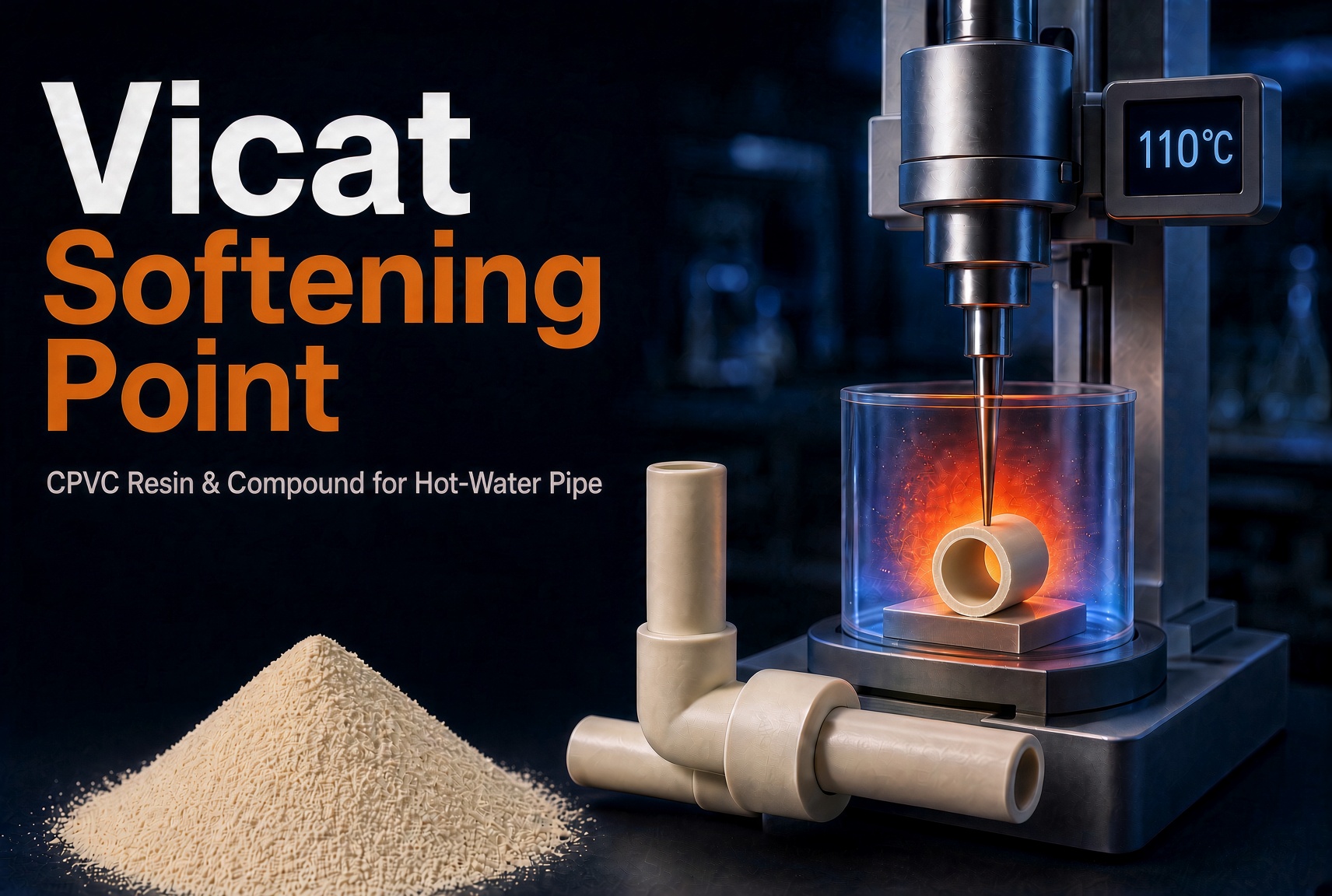
Chlorine content is not a substitute for Vicat softening temperature, thermal stability, or processing-temperature guidance. Each answers a different question.
Why Higher Chlorine Content Is Not a Complete Buying Rule
Extra chlorine raises the heat resistance of the polymer compared with PVC. That is the main reason hot-water pipe moves off ordinary PVC compound. PVC compound is commonly limited to about 60°C (140°F). CPVC sits above that. See CPVC vs PVC.
Higher chlorine is not automatically a better purchase. Molecular weight, the additive package, and the way the material is processed all change how the resin behaves on a line. A higher chlorine number does not, by itself, prove better long-term performance or easier processing.
Chlorine content that sits too high can raise viscosity and narrow the processing window. The usable range for hot-water pipe resin is typically kept where the material still processes cleanly. Without a matching trial on your equipment, treat chlorine content as one input, not the whole decision.
The practical question is simple: Will this resin work in our formulation and process to produce parts that meet our requirements? A chlorine-content percentage gives part of that answer, not the whole answer.
Do Extrusion and Injection Plants Need Different Chlorine Specifications?
Extrusion and injection molding place different demands on a formulated material. They do not automatically require different chlorine floors. Select a resin for its intended process, then review the full sheet: chlorine content, Vicat, thermal stability, particle size, and how the material runs on the line.
XUYE’s resin TDS documents identify J-700 for CPVC tube extrusion and Z-500 for CPVC fittings and other injection applications.
| Resin grade | Intended application | Typical chlorine-content value listed in the TDS (%) |
| J-700 | CPVC tube extrusion | ≥67 |
| Z-500 | CPVC fittings and other injection applications | ≥66 |
XUYE can discuss grade-specific production and formulation requirements for different manufacturing needs. Available customization, technical feasibility, and acceptance criteria should be agreed for the selected grade and order.
What Should Resin Buyers Specify and Verify?
If you compound in-house, the resin TDS is the starting point. Turn its information into a purchasing specification by clarifying these items.
| Item | What to confirm |
| Grade and application | The resin offered and its intended processing route |
| Material tested | Whether the chlorine-content result describes the base resin |
| Value type | Whether the entry is typical information, a specified range, a limit, or a batch result |
| Test basis | The method, sample preparation, and reporting basis |
| Other resin properties | The characteristics relevant to your formulation and equipment |
| Batch documentation | Available test records, batch identification, and traceability |
| Qualification plan | Formulation trials, processing checks, and finished-product tests |
| Order requirements | Any customized specifications and agreed acceptance criteria |
Separate typical data from order requirements
A TDS presents product information. An agreed order specification establishes the requirements for a particular supply. A certificate of analysis, where available, provides results for an identified batch.
For example, a typical entry of ≥67% does not tell you the exact chlorine content of a delivered batch or how much results vary between batches. Ask which records are available and agree on the checks needed for incoming material.
Qualify the resin in your own formulation
Review the material with your formulation and processing team. Establish trial objectives and the checks required before routine supply. A resin meeting a listed chlorine-content value still needs to be evaluated for the intended formulation, process, and finished product.
What Should Compound Buyers Check Instead of Relying on Resin Chlorine Content Alone?
Buying a ready compound is a different task. The resin chlorine number is useful background. It is not the number that decides whether the compound will run.
Check these six areas:
- Application and grade. Confirm whether the material is proposed for pipe extrusion, fitting injection molding, or another process.
- Supply form and preparation. Confirm the supplied form, storage requirements, and any preparation needed before processing.
- Relevant properties. Review the mechanical and thermal data, together with their test methods and conditions.
- Production fit. Discuss equipment, product geometry, and trial objectives with the supplier.
- Supply controls. Clarify available batch documents, traceability, and notification of material changes.
- Product verification. Define the checks the manufactured pipe or fitting must pass.
XUYE offers J-700C CPVC compound for pipe extrusion and Z-500C compound for fitting and valve-related injection applications. Grade suitability should be confirmed against the intended requirements and trials.
Why Chlorine Content Does Not Determine a Finished Pipe’s Rating
Resin properties, compound performance, and finished-product ratings are different levels of evaluation.
A finished pipe’s performance depends on the formulated material, manufacturing process, dimensions, and the conditions for which the product has been tested. A resin chlorine-content figure alone cannot establish the pipe’s allowable service temperature, pressure rating, chemical suitability, or expected life.
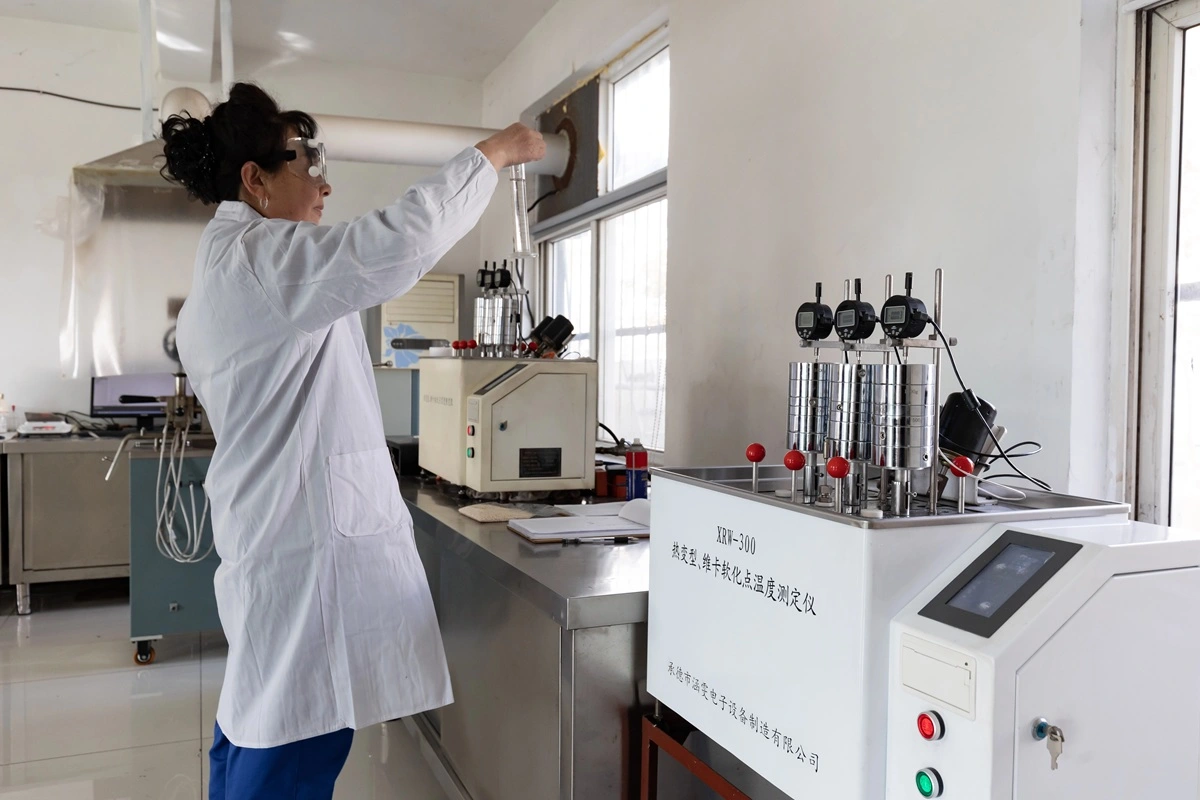
Vicat softening temperature is a material test result, not the temperature at which a pipe is automatically rated for continuous service. For details on testing and reporting, read the Vicat testing guide.
Define the intended application and applicable product requirements first. Then verify that the manufactured pipe or fitting meets those requirements. A material TDS supports selection. It does not replace finished-product qualification.
A Checklist for Your Next CPVC Material Inquiry
To help a supplier evaluate your request, provide:
- Application: What the pipe, fitting, or component will be used for.
- Process: Extrusion or injection molding, with relevant equipment details.
- Purchasing route: Base resin for in-house compounding or a prepared compound.
- Target requirements: Product standards, customer specifications, and performance objectives.
- Current challenge: A new formulation, supply change, or production issue to investigate.
- Documents needed: Current TDS, test-method clarification, and available batch records.
- Trial plan: Sample requirements and planned acceptance checks.
Review XUYE’s technical documents and share your application, processing route, and target requirements. Our team can discuss grade selection, available customization, and the next steps for evaluation.
Contact technical support to discuss your material requirements before a production trial.
Frequently Asked Questions
Is higher chlorine content always better for CPVC resin?
No. Chlorine content is one selection factor. Resin characteristics, formulation, processing requirements, and finished-product performance must be considered together. Choose a grade for the intended application rather than the highest percentage alone.
Is CPVC resin chlorine content the same as compound chlorine content?
Not necessarily. A compound includes the base resin and other formulation components, so its overall chlorine content can differ. Confirm whether a reported figure describes the resin or the complete compound before comparing values.
Can chlorine content determine a CPVC pipe’s temperature rating?
No. A resin chlorine-content figure alone does not establish a pipe’s temperature rating, pressure rating, or service life. Those require evaluation of the manufactured product for its intended use and applicable requirements.