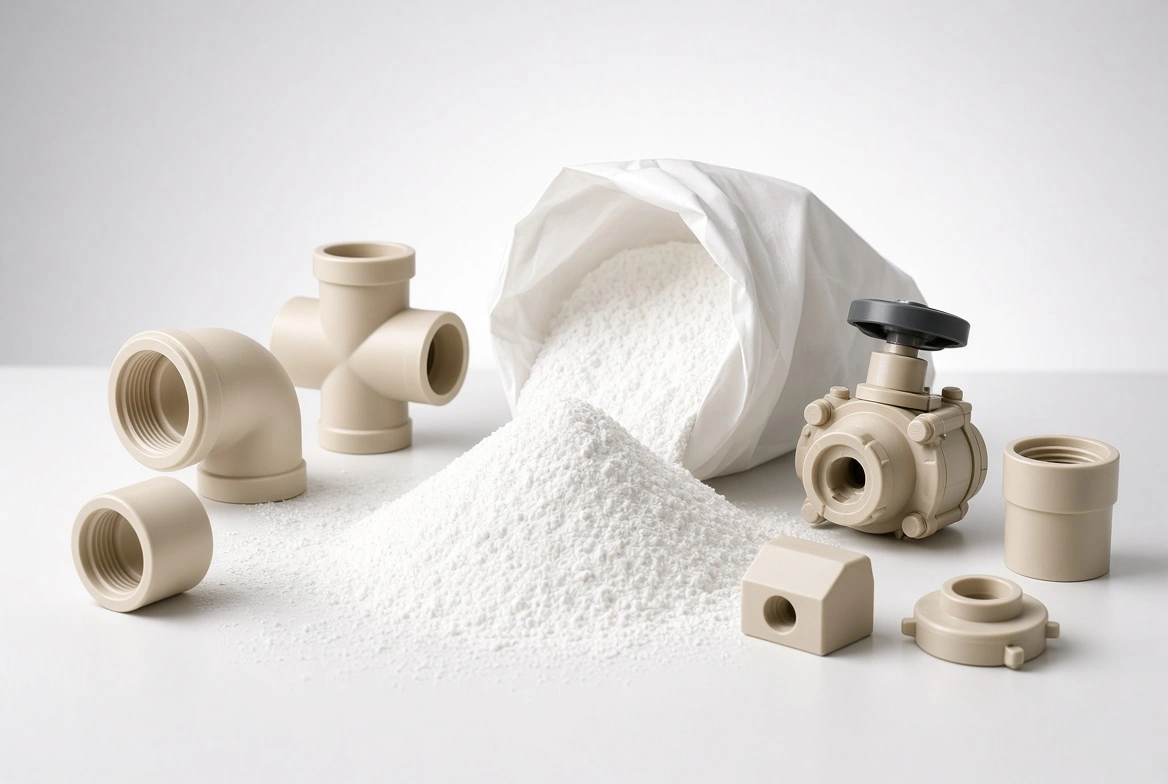
射出成形されたフィッティング、バルブ、および複雑な成形部品には、射出成形グレードのCPVC樹脂が必要です。押出成形グレードの樹脂はパイプ製造用に設計されており、これらの部品に必要な流動性、充填性、およびウェルドラインの性能を提供できません。誤ったベース樹脂を使用すると、充填不足、弱いウェルドライン、寸法の不一致、およびスクラップ率の上昇を招きます。
本ガイドでは、配合設計者や成形業者が直面する具体的な課題と、適切な射出成形グレードの樹脂を選択する方法について解説します。
なぜ射出成形グレードの樹脂が必要なのか
パイプの押出成形と射出成形では、樹脂に対する優先順位が正反対です。
- 押出成形 ダイから押し出されたパイプの形状を維持するために、溶融強度を優先します。
- 射出成形 高いせん断力の下で長い流路、薄肉部、複雑な形状を充填し、耐久性のあるウェルドラインを形成することを優先します。
射出成形グレードの樹脂は、この領域に適した特性を備えています。その分子量特性、塩素含有量の範囲、および熱安定性は、過度な劣化を伴わずに充填および保圧を行うことを可能にします。配合設計者にとって、ベース樹脂は利用可能な加工許容範囲を決定し、最終的なコンパウンドが重要な部品においてどれだけ一貫した性能を発揮するかを左右します。
1. フィッティング — 流路、遷移部、寸法
何が問題となるのか
- 長い流動長と急激な肉厚変化
- 充填不足、フローマーク、または遷移部でのバリ
- 高応力ゾーンに形成されるウェルドライン
- ソケットおよび溶剤溶接エリアの表面品質の低下
なぜ重要なのか
弱いウェルドラインは、耐圧試験の不合格や長期的なクリープ現象の原因となります。粗い、または不均一な溶剤溶接面は、接合強度を低下させ、漏れのリスクを高めます。結果として、スクラップの増加、不適切な嵌合、または高コストな現場での故障につながります。
2. バルブ — シール面と耐圧性
何が問題となるのか
- 不正確なシール溝と座面
- 厚肉部の不十分な保圧
- システム圧力および動作トルク下での弱いウェルドライン
- 熱や化学物質への曝露による寸法変化
なぜ重要なのか
シール性能が低下し、耐圧試験の不合格率が上昇します。また、特に温水や強力な化学物質を使用する場合、使用中に早期の亀裂が発生する可能性があります。
3. 複雑な成形部品 — 形状と 一貫性
何が問題となるのか
- 薄肉部、深いリブ、および大きな投影面積
- 溶融粘度と保圧挙動に対する高い感度
- バッチ間の寸法変動
- 複雑な金型における表面および離型性の問題
なぜ重要なのか
寸法の不一致は、組み立てや漏れ試験の問題となります。樹脂が形状に適合していない場合、反り、サイクルタイムの延長、および歩留まりの不安定化が発生します。
射出成形グレードの樹脂が役立つ理由
専用に設計された射出成形グレードのCPVC樹脂は、以下の4つの実用的な方法でこれらの部品をサポートします。
- 優れた流動性 — 過度な圧力や劣化を伴わずに、長い流路や薄肉部を充填します
- 十分な熱安定性 — 高いせん断力や長い滞留時間の間、ポリマーを保護します
- 一貫した粒子サイズと低い揮発分 — promote uniform melting and reduce surface defects
- More formulation latitude — gives room to balance lubricants, stabilizers, and impact modifiers
Result: more reliable knit-line strength, tighter dimensional control, and a more predictable processing window.
4 Setps to Select the Right Resin
Not every CPVC resin is formulated for injection molding of fittings and valves. Matching the base resin to the injection window reduces trial-and-error and improves first-pass success. Here goes the selection sequence:
- Define part priorities
- Fittings → dimensional stability, weld-line strength, surface quality for solvent welding
- Valves → sealing-surface precision, pressure integrity, chemical resistance
- Complex molded parts → flow window, low warpage, surface consistency
- Match the resin to the injection window
Look for suitable chlorine content および Vicat range, thermal stability for expected cycle times, and particle-size/volatile characteristics that support clean melting.
- Check formulation compatibility
Confirm the resin works with common stabilizers, lubricants, and impact modifiers, and leaves enough processing latitude for production-scale molding.
- Validate on real parts
Run critical geometries—especially those with knit lines or sealing surfaces. Prioritize checking knit-line location and strength, plus dimensional accuracy on sealing surfaces and solvent-weld areas. Assess fill, surface quality, and short-term pressure or chemical performance before scaling.
Choosing a Base Resin
Once the requirements are clear, select a consistent injection-grade CPVC resin designed for these applications.
Xuye Z-500 is an injection-grade CPVC resin developed for formulation teams working on fittings, valves, and molded components. With chlorine content ≥66%, it provides the base material characteristics needed to support the flow, thermal stability, and dimensional performance outlined above.
Full specifications, test data, and sample support:
Xuye Z-500 injection-grade CPVC resin
Closing
Fittings, valves, and complex molded parts require injection-grade CPVC resin. Extrusion-grade materials are not optimized for their flow, knit-line, and dimensional demands. Understanding these challenges and following a clear selection sequence reduces development time and improves first-pass success.
Start with a purpose-designed injection-grade resin and validate on critical geometries. When ready to review data or request samples, use the Z-500 product page for specifications and technical support.