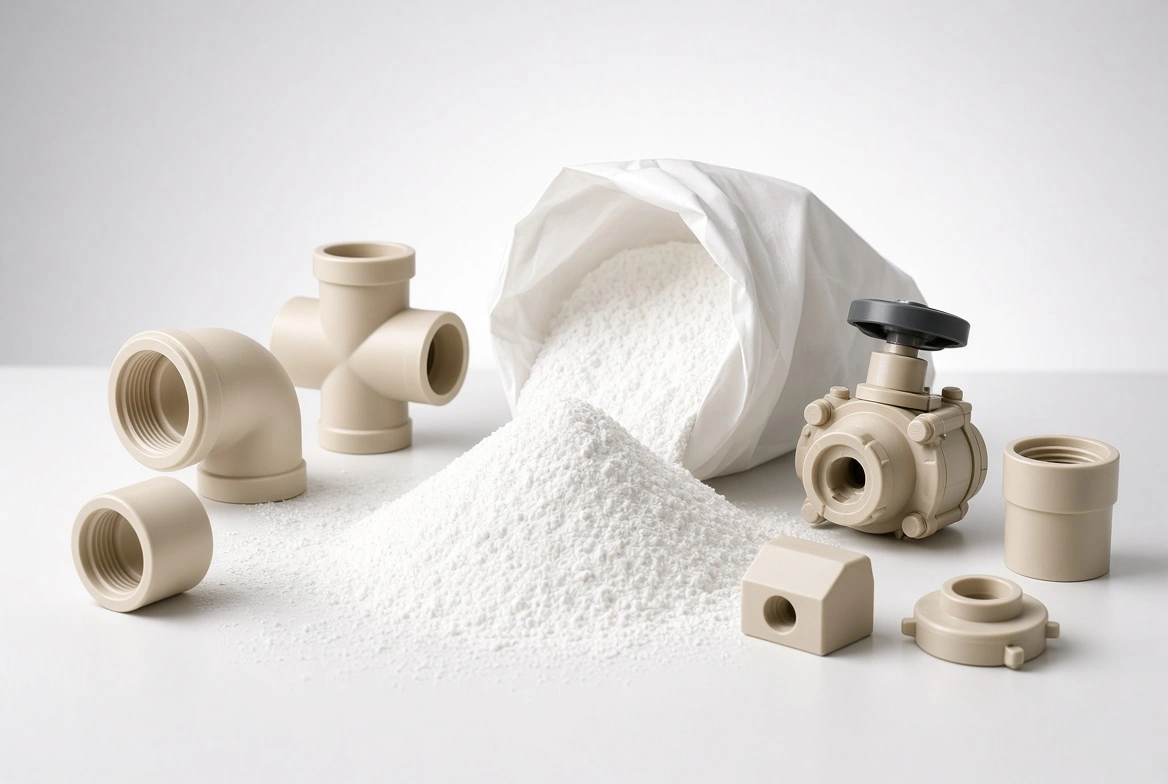
사출 성형 피팅, 밸브 및 복잡한 성형 부품에는 사출 등급 CPVC 수지가 필요합니다. 압출 등급 수지는 파이프 생산용으로 설계되었으며 이러한 부품에 필요한 유동성, 패킹 및 니트 라인 성능을 제공하지 못합니다. 잘못된 기본 수지를 사용하면 충전 불완전, 약한 웰드 라인, 치수 불일치 및 높은 불량률이 발생합니다.
이 가이드는 배합자와 성형업체가 직면하는 구체적인 과제와 올바른 사출 등급 수지를 선택하는 방법을 설명합니다.
사출 등급 수지가 필요한 이유
파이프 압출과 사출 성형은 수지에 대해 상반된 우선순위를 가집니다.
- 압출 다이(die)를 빠져나올 때 파이프 모양을 유지하기 위한 용융 강도를 우선시합니다.
- 사출 성형 더 높은 전단력 하에서 긴 유로, 얇은 벽 및 복잡한 형상을 채우고 내구성 있는 니트 라인을 형성하는 것을 우선시합니다.
사출 등급 수지는 이러한 공정 범위에 맞춰져 있습니다. 분자량 특성, 염소 함량 범위 및 열 안정성은 과도한 열화 없이 충전 및 패킹을 지원합니다. 배합자에게 있어 기본 수지는 가용 공정 범위를 설정하며 최종 컴파운드가 중요한 부품에서 얼마나 일관되게 성능을 발휘할지를 결정합니다.
1. 피팅 — 유로, 전이 구간 및 치수
발생하는 문제
- 긴 유동 길이 및 급격한 벽 두께 변화
- 전이 구간에서의 충전 불완전, 흐름 자국 또는 플래시
- 고응력 구역에 형성되는 니트 라인
- 소켓 및 솔벤트 용접 부위의 낮은 표면 품질
중요한 이유
약한 웰드 라인은 압력 테스트 실패나 장기적인 크리프 현상을 유발합니다. 거칠거나 일관되지 않은 솔벤트 용접 표면은 접합 강도를 감소시키고 누출 위험을 증가시킵니다. 결과: 더 높은 불량률, 일관되지 않은 조립 상태 또는 비용이 많이 드는 현장 고장.
2. 밸브 — 밀봉 표면 및 압력 무결성
발생하는 문제
- 부정확한 밀봉 홈 및 안착면
- 두꺼운 섹션의 불충분한 패킹
- 시스템 압력 및 작동 토크 하에서의 약한 니트 라인
- 열 또는 화학 물질 노출 하에서의 치수 변화
중요한 이유
밀봉 성능이 저하되고, 압력 테스트 거부율이 상승하며, 특히 온수나 공격적인 화학 물질을 사용할 경우 서비스 중에 조기 균열이 나타날 수 있습니다.
3. 복잡한 성형 부품 — 형상 및 일관성
발생하는 문제
- 얇은 벽, 깊은 리브 및 넓은 투영 면적
- 용융 점도 및 패킹 거동에 대한 높은 민감도
- 배치 간 치수 변동
- 복잡한 툴링으로 인한 표면 및 탈형 문제
중요한 이유
치수 불일치는 조립 또는 누출 테스트 문제가 됩니다. 수지가 형상과 일치하지 않으면 뒤틀림, 더 긴 사이클 타임 및 불안정한 수율이 뒤따릅니다.
사출 등급 수지가 도움이 되는 방법
목적에 맞게 설계된 사출 등급 CPVC 수지는 다음과 같은 네 가지 실용적인 방식으로 이러한 부품을 지원합니다.
- 더 나은 유동성 — 과도한 압력이나 열화 없이 긴 경로와 얇은 섹션을 채웁니다.
- 적절한 열 안정성 — 더 높은 전단력과 더 긴 체류 시간 동안 폴리머를 보호합니다.
- 일관된 입자 크기 및 낮은 휘발성 — promote uniform melting and reduce surface defects
- More formulation latitude — gives room to balance lubricants, stabilizers, and impact modifiers
Result: more reliable knit-line strength, tighter dimensional control, and a more predictable processing window.
4 Setps to Select the Right Resin
Not every CPVC resin is formulated for injection molding of fittings and valves. Matching the base resin to the injection window reduces trial-and-error and improves first-pass success. Here goes the selection sequence:
- Define part priorities
- Fittings → dimensional stability, weld-line strength, surface quality for solvent welding
- Valves → sealing-surface precision, pressure integrity, chemical resistance
- Complex molded parts → flow window, low warpage, surface consistency
- Match the resin to the injection window
Look for suitable chlorine content 및 Vicat range, thermal stability for expected cycle times, and particle-size/volatile characteristics that support clean melting.
- Check formulation compatibility
Confirm the resin works with common stabilizers, lubricants, and impact modifiers, and leaves enough processing latitude for production-scale molding.
- Validate on real parts
Run critical geometries—especially those with knit lines or sealing surfaces. Prioritize checking knit-line location and strength, plus dimensional accuracy on sealing surfaces and solvent-weld areas. Assess fill, surface quality, and short-term pressure or chemical performance before scaling.
Choosing a Base Resin
Once the requirements are clear, select a consistent injection-grade CPVC resin designed for these applications.
Xuye Z-500 is an injection-grade CPVC resin developed for formulation teams working on fittings, valves, and molded components. With chlorine content ≥66%, it provides the base material characteristics needed to support the flow, thermal stability, and dimensional performance outlined above.
Full specifications, test data, and sample support:
Xuye Z-500 injection-grade CPVC resin
Closing
Fittings, valves, and complex molded parts require injection-grade CPVC resin. Extrusion-grade materials are not optimized for their flow, knit-line, and dimensional demands. Understanding these challenges and following a clear selection sequence reduces development time and improves first-pass success.
Start with a purpose-designed injection-grade resin and validate on critical geometries. When ready to review data or request samples, use the Z-500 product page for specifications and technical support.