When choosing materials for industrial piping systems, resistance to corrosion is one of the most important factors to consider. Chloride ions (Cl⁻) are known to cause severe corrosion in metals, leading to leaks, failures, and high maintenance costs. However, chlorinated polyvinyl chloride (CPVC) stands out as a durable and corrosion-resistant material, widely used in applications where chloride exposure is unavoidable. Understanding why CPVC performs so well in chloride-rich environments helps explain its popularity in chemical processing, desalination, and water treatment industries.
Understanding Chloride Ion Corrosion in Industrial Systems
Chloride-induced corrosion is a common problem in metal piping systems, especially in environments with saltwater, chemical brines, or acidic solutions. Chloride ions penetrate protective oxide films on metal surfaces, causing pitting and stress corrosion cracking (SCC). Once the protective layer is damaged, the corrosion process accelerates, leading to structural weakening and system failure.
In contrast, CPVC is not a metal—it is a high-performance thermoplastic material that resists this type of chemical attack. Unlike metals, CPVC does not rely on a passive layer for protection. Instead, its molecular structure inherently resists chloride ion degradation.
High Chlorine Content and Molecular Structure Stability
One of the main reasons CPVC performs so well in corrosive environments is its unique chemical composition. CPVC is produced by chlorinating polyvinyl chloride (PVC), increasing the chlorine content from around 56.7% to more than 67%. This additional chlorine changes the polymer’s molecular structure and improves its thermal and chemical resistance.
Each chlorine atom in CPVC is covalently bonded to the carbon backbone through a C–Cl bond, which has a high bond energy of approximately 327 kJ/mol. This strong bond is extremely stable and difficult to break under normal industrial conditions. Furthermore, the large chlorine atoms create a “shielding effect,” known as the steric effect, that protects the carbon backbone from external chemical attacks—including from chloride ions themselves.
In short, the combination of high chlorine content and strong molecular bonding gives CPVC its remarkable durability and long-term stability in corrosive service environments.
Chemical Inertness and Resistance to Oxidizing Agents
Another key advantage of CPVC is its high level of chemical inertness. Corrosion typically involves redox (oxidation-reduction) reactions that alter the material’s structure. However, the carbon atoms in CPVC are already surrounded by chlorine, one of the most electronegative elements. This means CPVC’s molecular chains are in a “highly oxidized” and electron-deficient state, making further oxidation nearly impossible.
Because of this, CPVC shows excellent resistance to oxidizing acids such as nitric acid and chromic acid, as well as to solutions containing chlorine and other halogens. Chloride ions have no active sites to attack within the CPVC polymer, which explains why the material remains stable even in environments that quickly degrade other plastics and metals.
In practical terms, this chemical inertness translates to lower maintenance needs, reduced risk of chemical degradation, and longer service life for CPVC systems.
No Electro chemical Corrosion Mechanism
Corrosion in metals is primarily an electrochemical process—chloride ions act as catalysts that break down protective films and facilitate electron flow between anodic and cathodic sites. This results in the metal dissolving over time.
CPVC, on the other hand, is a non-metallic and non-conductive material. It has no free electrons or ions to support electrochemical reactions. Therefore, it completely avoids the type of corrosion caused by chloride ions in metals. Any potential degradation of CPVC would only occur through extreme physical swelling or chemical attack under unusually harsh conditions, rather than through electrochemical corrosion.
This fundamental difference is one of the main reasons why CPVC outperforms metals like stainless steel in chloride-containing environments.
Proven Resistance and Industrial Test Data
The superior corrosion resistance of CPVC is supported by extensive laboratory and field data. CPVC can withstand any concentration of chloride ion solutions—such as sodium chloride (NaCl), calcium chloride (CaCl₂), and potassium chloride (KCl)—at its maximum operating temperature.
For example, in saturated saltwater, CPVC can operate continuously at temperatures up to 90°C without noticeable degradation. By comparison, 304 stainless steel may experience stress corrosion cracking at temperatures above 60°C when exposed to chlorides. In chemical compatibility charts, CPVC consistently receives an “Excellent” rating for resistance to chloride salts, indicating negligible weight change, strength loss, or surface damage after prolonged exposure.
This proven durability makes CPVC one of the most reliable materials for chloride-bearing environments.
Common Applications in Chloride-Rich Environments
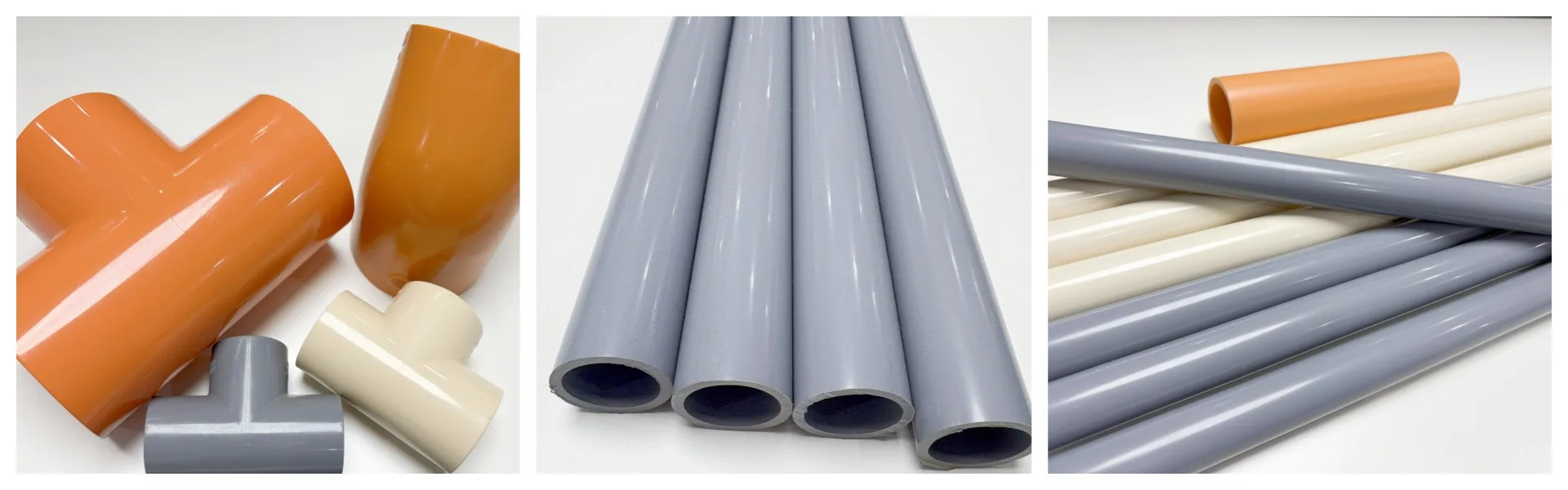
Thanks to its chemical resistance and long-term stability, CPVC is widely used in industries where contact with chloride ions is unavoidable. Common applications include:
- Desalination plants: for seawater transport and brine discharge lines.
- Chemical processing facilities: for handling chlorinated solutions and saline waste streams.
- Electroplating plants: for conveying acids and chloride-based plating fluids.
- Swimming pool systems: for chlorinated water circulation and treatment lines.
In all these applications, CPVC piping provides a combination of corrosion resistance, mechanical strength, and thermal stability that ensures safe and reliable operation.
Conclusion:The Science Behind CPVC’s Chloride Resistance
In conclusion, CPVC’s superior resistance to chloride ions originates from its molecular design rather than from coatings or additives. The strong C–Cl bonds, high chlorine content, and chemical inertness make CPVC inherently resistant to corrosion and chemical attack. Its non-conductive nature eliminates the risk of electrochemical corrosion, making it a trusted alternative to metal piping in chloride-rich and high-temperature environments.
For industries dealing with corrosive fluids, CPVC offers a durable, efficient, and cost-effective solution that ensures system reliability and extends service life.
As a leading chlorinated polyvinyl chloride (CPVC) supplier, Xuye New Materials Co., Ltd. specializes in the research and production of CPVC resins and CPVC compounds. With advanced formulations, professional R&D capabilities, and consistent quality, Xuye provides reliable CPVC materials for global customers in piping, fittings, coatings, and other industrial applications.
Choose Xuye — your trusted partner for high-performance and corrosion-resistant CPVC solutions.