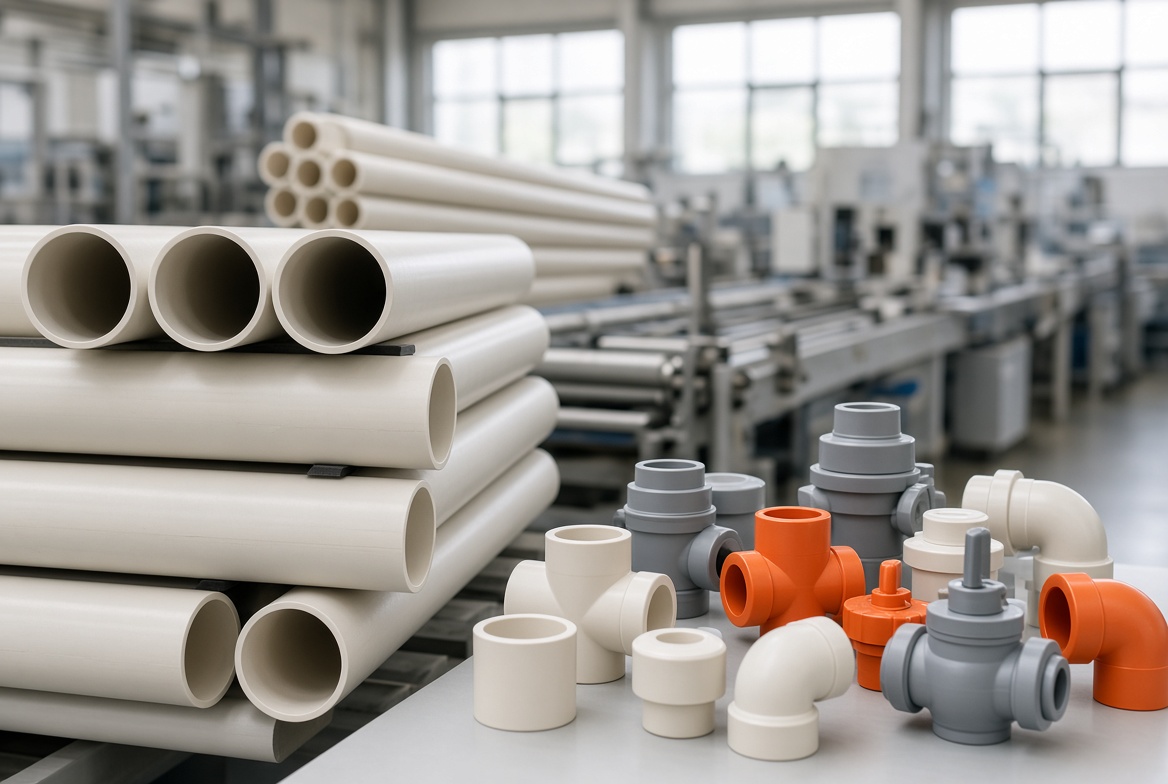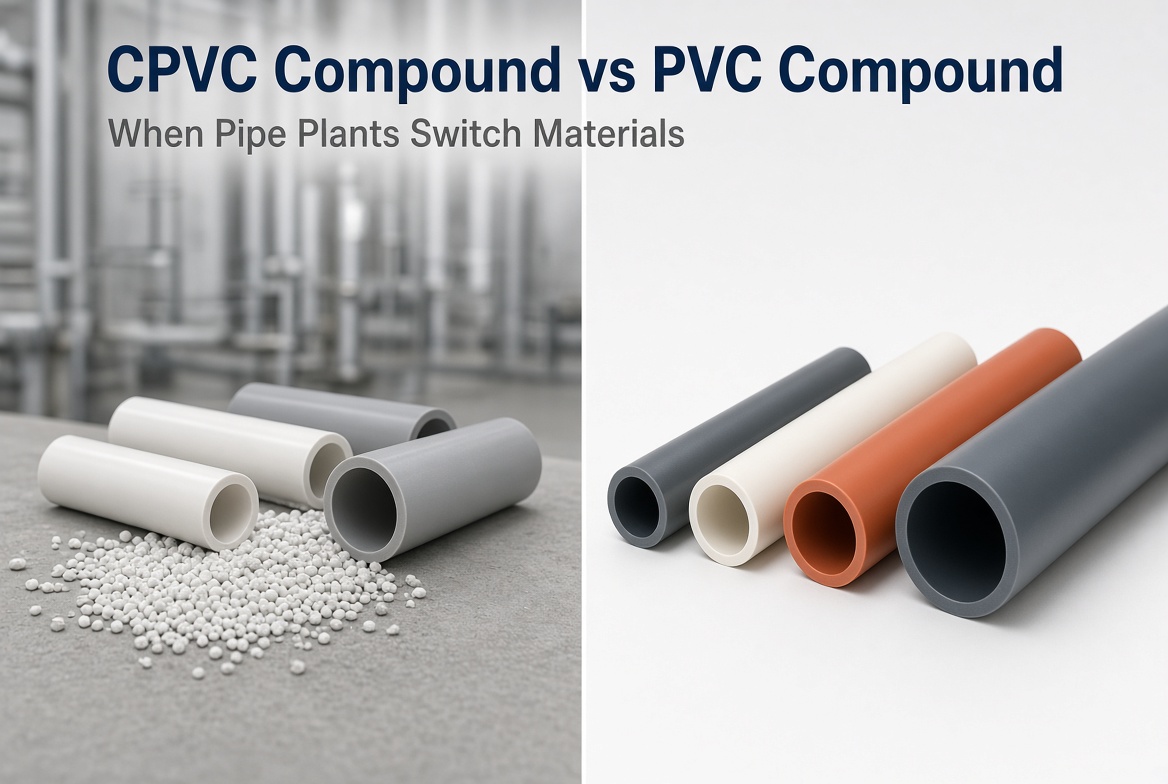
Le polychlorure de vinyle chloré (CPVC) est largement utilisé dans les tuyauteries, raccords et profilés industriels en raison de son excellente résistance à la chaleur, de sa résistance mécanique et de sa stabilité chimique. Cependant, lors de la transformation — en particulier par extrusion et moulage par injection — divers défauts tels que le brûlage, les marques d'air et les points blancs peuvent survenir. Comprendre les causes réelles de ces problèmes et mettre en œuvre des solutions ciblées est essentiel pour améliorer la qualité des produits et l'efficacité de la production.
1. Brûlage : le danger caché derrière un cisaillement élevé
Beaucoup supposent que le brûlage dans les produits en CPVC est causé par une température excessive, mais les causes réelles sont souvent mécaniques et opérationnelles. Le brûlage se produit lorsque des zones localisées du matériau dépassent la température de décomposition du CPVC (généralement 180–200 °C). Cela arrive principalement pour deux raisons : une vitesse de vis excessive et une mauvaise ventilation du moule.
Lorsque la vitesse de la vis est trop élevée, le matériau à l'intérieur du fourreau subit une contrainte de cisaillement excessive, générant une chaleur localisée qui dépasse la limite de transformation sécurisée. Le problème est plus grave dans les zones d'alimentation et de compression, où le matériau reste exposé à la chaleur pendant de plus longues périodes, entraînant une carbonisation partielle. De plus, des évents obstrués dans le moule empêchent la libération des composés volatils générés lors de la fusion. Lorsque ces gaz s'accumulent sous une température et une pression élevées, ils s'enflamment ou brûlent, laissant des marques de brûlure sombres sur la surface.
Pour éviter le brûlage, une approche précise est nécessaire. Premièrement, réduisez la vitesse de la vis de 5 à 10 % pour abaisser le taux de cisaillement, et surveillez en continu la température du fourreau pour vous assurer que la température réelle ne dépasse pas la valeur définie de plus de ±3 °C. Deuxièmement, nettoyez les évents du moule avant chaque démarrage. Utilisez un fil de cuivre fin pour éliminer toute obstruction et, si nécessaire, agrandissez les fentes d'évent pour améliorer l'évacuation des gaz. Ces petits ajustements peuvent améliorer considérablement l'aspect de la surface et réduire les taux de retouche.
2. Marques d'air : un défaut d'aspect courant mais évitable
Parmi tous les défauts de transformation du CPVC, les marques d'air (ou “ stries de gaz ”) sont parmi les plus courantes et les plus visibles. Elles apparaissent sous forme de lignes troubles ou argentées sur la surface de la pièce moulée et résultent principalement de l'air ou de l'humidité emprisonnés. Les causes principales peuvent être regroupées en trois domaines : une teneur élevée en humidité de la matière première, l'air emprisonné lors de l'alimentation et une conception inappropriée du point d'injection.
Comme le CPVC possède de fortes propriétés hygroscopiques, un séchage inadéquat est souvent le principal coupable. Si la teneur en humidité dépasse 0,1 %, l'eau résiduelle s'évapore en vapeur lors de la fusion, formant des stries lorsqu'elle est piégée dans le polymère fondu. L'air peut également pénétrer dans le fourreau lorsqu'il y a un jeu excessif entre la vis et le fourreau ou lorsque la vis se rétracte, permettant à l'air de se mélanger au matériau. Enfin, des points d'injection mal conçus — en particulier lorsque le débit est trop élevé — peuvent provoquer des turbulences, emprisonnant l'air dans le flux fondu.
Les solutions sont simples et efficaces. Premièrement, séchez la résine CPVC à 80–90 °C pendant 4 à 6 heures et stockez-la dans des conteneurs scellés pour éviter la réabsorption d'humidité. Deuxièmement, inspectez le jeu entre la vis et le fourreau ; s'il dépasse 0,2 mm, remplacez rapidement les pièces usées. L'ajout d'un clapet anti-retour au niveau de la gorge d'alimentation peut réduire davantage l'entraînement d'air. Enfin, optimisez la conception du point d'injection — les points d'injection en éventail ou ponctuels peuvent aider à ralentir le flux et à réduire les turbulences. L'ajout d'évents auxiliaires près des zones sujettes aux marques d'air aide également l'air à s'échapper efficacement.
3. Points blancs : un symptôme de mauvaise formulation ou de mélange insuffisant
Les points blancs sont un autre problème fréquent lors de la transformation du CPVC. Bien que de nombreux opérateurs les attribuent à des impuretés dans la matière première, les raisons réelles résident souvent dans la conception de la formulation, le contrôle de la température et les performances de plastification.
Les composés de CPVC modifiés mal formulés peuvent avoir des fenêtres de transformation étroites et de mauvaises caractéristiques d'écoulement, ce qui provoque des marques d'écoulement ou des stries blanches lors du moulage. Un autre facteur majeur est la basse température du moule. Si la surface du moule est trop froide, le matériau fondu se solidifie rapidement au contact, formant une fine couche superficielle. À mesure que la matière fondue interne continue de s'écouler, cette fine coque s'étire et crée des points blancs visibles. Enfin, un mélange inadéquat ou une mauvaise conception de la vis peut entraîner une fusion incomplète du matériau, laissant de petites particules non fondues qui apparaissent comme des taches blanches après le moulage.
Pour résoudre ces problèmes, le contrôle qualité doit commencer dès la préparation du matériau. Suivez toujours la formulation recommandée et assurez-vous que les stabilisants et les additifs sont mélangés uniformément. Lors du mélange, pré-mélangez les stabilisants avec une petite partie de la résine avant d'ajouter le reste pour assurer une dispersion uniforme. Ensuite, augmentez la température du moule à 50–60 °C pour favoriser un refroidissement uniforme de la surface et éliminer le retrait différentiel. Si la vis ne permet pas un mélange suffisant, envisagez d'ajuster le taux de compression ou de la remplacer par une vis incluant une tête de mélange ou une barrière. Ces améliorations aident à obtenir une qualité de fusion constante et à réduire les défauts visibles.
4. Construire un système de transformation du CPVC stable
Éviter les défauts du CPVC nécessite plus que le dépannage de problèmes individuels — cela exige un contrôle systématique de l'ensemble du processus. Les opérateurs doivent maintenir des conditions d'équipement stables, nettoyer et calibrer régulièrement les outils de transformation, et enregistrer toutes les données de température et de pression pour la traçabilité. L'utilisation de composés CPVC de haute qualité avec des systèmes de stabilisation optimisés peut également améliorer la stabilité de la transformation et réduire le risque de dégradation thermique.
Une surveillance constante, une maintenance préventive et une optimisation minutieuse des paramètres peuvent transformer la production d'une approche réactive à une approche proactive, garantissant à la fois performance et efficacité dans les applications en CPVC.
Conclusion
Comprendre les causes réelles des défauts de transformation courants du CPVC — tels que le brûlage, les marques d'air et les points blancs — permet aux fabricants de prendre des mesures correctives précises et efficaces. En optimisant la vitesse de la vis, en maintenant une ventilation appropriée, en assurant un séchage complet et en ajustant la formulation ou la conception de l'équipement, la qualité de la production peut être considérablement améliorée. Pour les entreprises à la recherche de matériaux CPVC stables et performants ainsi que d'un support technique professionnel, Xuye fournit des solutions fiables adaptées à vos besoins.
Choisissez Xuye — votre partenaire de confiance pour les matériaux CPVC avancés et l'expertise en transformation.